Vanda Orchid Care Guide: The Orchid That Refuses to Be Ordinary
- Jonny Balchandani
- Apr 15
- 4 min read


There are plants you own…
…and then there are plants that completely change how you understand growing.
The Vanda sits firmly in that second category.
It doesn’t sit in soil.
It doesn’t follow the rules.
And it certainly doesn’t tolerate being treated like everything else on your shelf.
A Vanda hangs.
Roots exposed. Leaves reaching. Flowers arriving like something that shouldn’t exist in nature, yet somehow does.
At first glance, it looks high maintenance. A plant for greenhouses, collectors, people with mist rolling through their homes at sunrise.
But that’s the illusion.
Because once you understand where it comes from… and more importantly, how it thinks… everything about it becomes surprisingly simple.
Born in the Air, Not the Ground
Vandas don’t come from pots. They don’t come from tidy garden centres with labels and instructions.
They come from the humid, tangled, light-drenched forests of Southeast Asia. Places like Thailand, India, and the Philippines, where the air feels thick enough to drink and everything is alive at once.
But here’s the detail that changes everything. They don’t grow in soil. They grow on trees.

Not feeding from them, not harming them, just… using them as a place to exist. Anchored lightly, while their roots spill out into the open air, catching rain as it falls, drinking humidity as it passes, breathing constantly.
So when a Vanda struggles in someone’s home, it’s rarely because the plant is “difficult.”
It’s because it’s been asked to live a life it was never designed for.
The Roots That Tell the Truth
If you really want to understand a Vanda, don’t look at the leaves.
Look at the roots.

Thick, rope-like, almost alien in appearance, they hang freely as if they’ve got somewhere better to be. Covered in a soft, absorbent layer, they react instantly to water. One moment silver and quiet, the next a vivid, living green.
It’s one of the few plants that doesn’t leave you guessing.
It shows you exactly how it feels.
Hydrated. Dehydrated. Thriving. Struggling.
It’s all there, right in front of you.
And here’s the part most people don’t realise.
Those roots aren’t just drinking.
They’re feeding.
They photosynthesise. They generate energy. They are as much a part of the plant’s survival as the leaves themselves.
Which means the moment you hide them away, bury them, or restrict them…
you take away part of what makes the plant work.
A Vanda is not meant to be contained.
It’s meant to be understood.
The Great Myth: “You Need a Jungle to Grow One”
This is where most people walk away.
They hear “tropical orchid” and picture glasshouses, humidity meters, and daily rituals that feel more like a job than a hobby.
So they admire from a distance.
But here’s the truth that changes everything.
A Vanda can live very happily in a normal home.
No mist machines. No artificial jungle. No constant humidity.
What it needs is far simpler than that.
It needs rhythm.

In the wild, rain doesn’t politely arrive once a week. It comes in waves. It drenches everything, then disappears, leaving the plant to dry, breathe, and reset before the next downpour.
That’s all you’re doing at home.
Replacing the rain.
A proper soak. A full drink. Roots turning green, coming alive, doing exactly what they were designed to do.
And then you leave it alone.
You let it dry. You let it breathe. You let it exist without interference.
People obsess over humidity when they should be focusing on this.
Because a well-watered Vanda in an average UK home will outperform a constantly damp one that never gets the chance to breathe.
Water and air. That’s the balance.
Get that right, and the rest follows.
Light: The Silent Decider
If watering is the heartbeat, light is the fuel.
A Vanda without enough light will grow. It will sit there, producing leaves, looking healthy enough to fool you.
But it won’t flower.
And with a plant like this, that’s missing the entire point.
They crave brightness. Not harsh, punishing sun that scorches and stresses, but strong, consistent light that fills a room and lingers throughout the day.
A bright window. A space that feels open. Somewhere the plant can stretch without reaching.
When they get it right, they don’t hesitate.
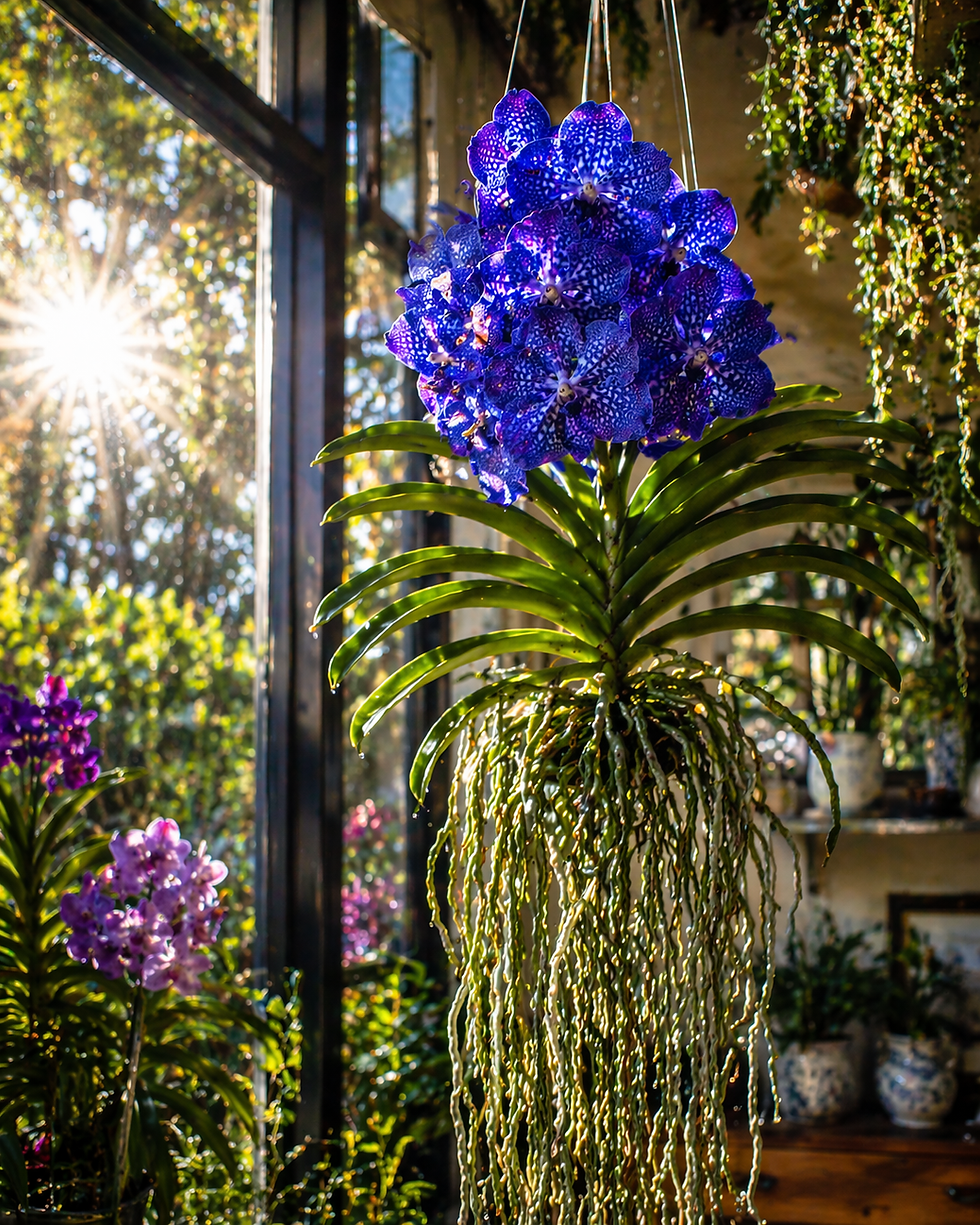
They produce flowers that look almost artificial in their perfection. Symmetrical, bold, unapologetically vibrant.
Blues that don’t seem real, thanks to species like Vanda coerulea, one of the few plants capable of producing a true blue pigment.
Not a hint of blue. Not a suggestion.
Actual blue.
And when those flowers arrive, they don’t rush off.
They stay. For weeks. Sometimes months. Holding their place like they know exactly what they are.
A Plant That Teaches You to Let Go
Most houseplants ask for control.
Schedules. Measurements. Precise routines.
Vandas ask for something different.
Awareness.
You can’t force them. You can’t shortcut them. You can’t ignore what they’re telling you and expect them to reward you anyway.
They teach you to watch.

To notice the shift in colour in the roots.
To understand the weight of hydration without touching the soil… because there is no soil.
To read the plant rather than follow a rulebook.
And once that clicks, something changes.
You stop guessing.
You start growing properly.
The Moment It All Pays Off
There’s a moment with a Vanda that people don’t talk about enough.
It’s not when you buy it.
It’s not even when you hang it up and step back thinking, “that looks decent.”
It’s when it flowers.
Properly flowers.
After you’ve watered it, watched it, adjusted your space, learned its rhythm…
…and it decides, on its own terms, that it’s happy.
The spike appears. Slowly at first. Then confidently.
And then the blooms open.
Not rushed. Not hesitant.
Just… there.
Perfect.

And in that moment, you realise something.
This wasn’t luck.
You didn’t just “keep it alive.”
You understood it.
Final Thoughts: Is a Vanda Worth It?

If you want easy, predictable, low-effort plants that sit quietly and behave…
this isn’t it.
But if you want something that changes how you see plants entirely…
something that demands a bit more from you, and gives far more back in return…
then a Vanda is exactly that.
Not just a plant.
A shift.
Give it light.
Water it properly.
Let it breathe.
And it won’t just grow in your home.
It’ll transform it.


Comments