The Bearded Plantaholic Presents: The Jungle Has Landed
- Jonny Balchandani
- Oct 23, 2025
- 10 min read

An intimate walk through the rarest foliage to ever grace British air.
When new stock lands, it doesn’t arrive quietly. It arrives like a thunderclap — boxes sweating from the flight, tape tearing like the start of a storm, and that first whiff of green: alive, wet, unapologetically wild. Every leaf in this shipment has a story, every vein an ancestry that stretches beyond memory.
Come with me. We’ll move through the crates together, one plant at a time, and I’ll show you what makes each of them more than a houseplant. These are relics, survivors, experiments of nature and accident — the sort of greenery that rewires how you see the colour green itself.
Anthurium luxurians × radicans — Armoured Elegance
At first glance it looks prehistoric, a reptile masquerading as foliage. This hybrid was born of two heavyweights: Anthurium luxurians, the Colombian low-forest bruiser, and A. radicans, the creeping Brazilian that roots wherever it can find moisture. Together they create a leaf so bullate, so heavily blistered, it feels like sculpted leather.
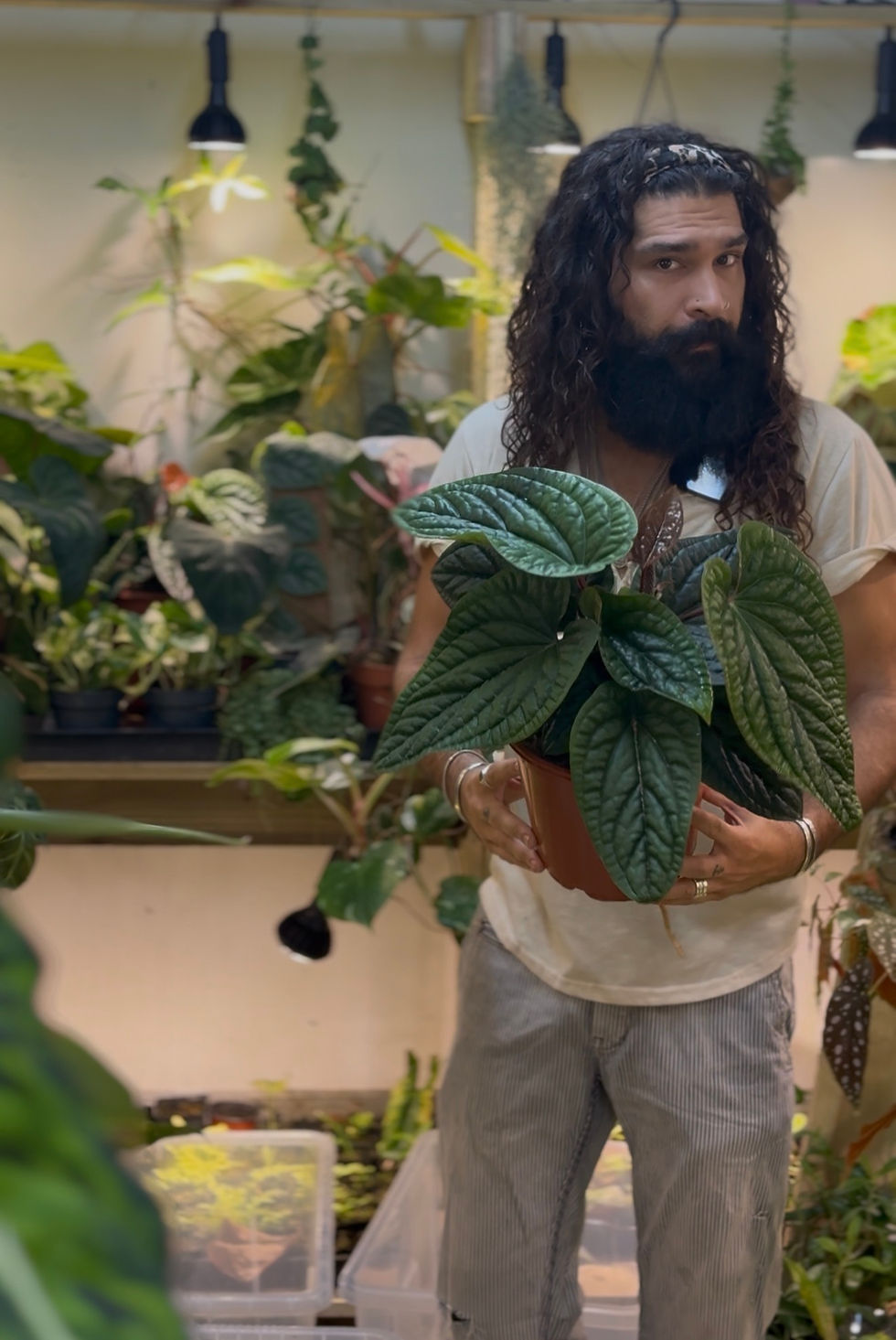
In the wild both parents live in the rain-dark understory — constant mist, heavy shadow, light sifting down through cathedral-thick canopy. For us in the UK, that translates to bright but indirect light, humidity hovering around 70 per cent, and a soil mix open enough to breathe. If your potting mix feels like pudding, start again.
That blistered texture isn’t decoration; it’s engineering. Each raised bubble sheds water instantly, stopping fungi before they start. Evolution’s answer to constant rain was to turn the leaf into a suit of armour — functional couture.
As it matures, the plant wants to climb. Give it height, a moss pole or slab, and it will reward you with thicker veins and darker sheen. Keep it cramped and it sulks. Treat it like royalty and it becomes a living fossil that somehow fits on a shelf.
Collectors love it because it looks indestructible. And in truth, it almost is.
Anthurium luxurians — The Rain-Forged Original

One of the parents of the hybrid above, A. luxurians doesn’t play at being dramatic; it is dramatic. Endemic to Colombia’s dripping jungles, it sits rooted in perpetual twilight, leaves glinting like oiled armour.
Those bullate surfaces are the result of constant water pressure. The plant evolved to let torrents roll off without tearing tissue. In human hands it prefers the same principle: wet air, moving air, but soil that drains fast.

In our grey island homes, “bright shade” means east or north-facing glass, warmth around 22 degrees, and patience. Each new leaf unfurls slowly, almost deliberately — a waxed-green reminder that good things ignore haste.
Give it that and you’ll see what collectors mean when they call it “prehistoric velvet.” Touch one, and every other plant feels pedestrian.
Anthurium veitchii — King of Corrugation
You don’t grow this plant so much as host it. A. veitchii, the so-called King Anthurium, hails from Colombia’s cloud forests, where mist moves like slow smoke and everything drips. It’s epiphytic, clinging to tree trunks, and its leaves can stretch longer than your arm.

The corrugation that gives it fame is a direct response to life in suspension. Those ribs stiffen the blade, helping it channel water while holding shape against wind. Under glasshouse conditions, leaves regularly top a metre and a half. Indoors, they’ll do half that if you give them altitude, humidity, and food in moderation.
In Britain, this translates to bright, filtered light — a south window softened by voile or an east window unfiltered. The air should move; the roots should breathe. Feed lightly; over-rich mixes flatten the ripples.
Every new leaf feels like a reward for restraint. You waited, you misted, you didn’t fuss — and the jungle answered.
Monstera ‘Burle Marx Flame’ — Botanical Fire in Motion
If sculpture could photosynthesise, this would be it. The Burle Marx Flame is Brazil distilled into one plant: flamboyant, mysterious, impossible to categorise. Discovered in the garden of landscape legend Roberto Burle Marx, its exact lineage remains a riddle. Some say a Monstera deliciosa variant, others whisper hybrid. Either way, its fenestrations curl like tongues of fire.
In its home climate the plant climbs through canopy gaps where sunlight flickers but never lingers. That means in the UK you want very bright indirect light, a sturdy pole, and room to ascend. Darkness yields juvenile leaves; height and light create infernos of green flame.
Those holes and splits aren’t whimsy; they’re aerodynamics. They let wind pass, reduce damage, and filter light more efficiently — evolution’s design for storm-proof photosynthesis.
Give it freedom and it becomes architecture. Restrain it and it behaves, but it’s a crime to make this species behave.
Philodendron squamiculatum ‘Red’ — The Fuzzy-Stemmed Show-Off
From the humid margins of northern South America, Philodendron squamiculatum grows as a hemi-epiphyte, sending furry red petioles toward the light. Those hairs aren’t cosmetic — they’re armour against insects and harsh sun. Up close, each stem looks dusted in crimson velvet.

In nature it clambers up trees under dappled brightness, absorbing the heat of the day and the cool of the night. Indoors it wants exactly that rhythm: bright but never direct light, a totem or board to scale, and soil that drains faster than you expect.
As it matures the leaves stretch into deep lobes, each new one a little more baroque. Handle it roughly and it forgives you; ignore it completely and it keeps climbing anyway. The fuzz collects dew, the leaves gather dust, and somehow it still looks like it owns the place.
Among aroid people, this is the plant equivalent of a loud laugh — unmissable, a bit ridiculous, and completely loveable.
Philodendron spiritus-sancti — The Holy Ghost of Espírito Santo

You can’t talk about rare aroids without invoking this legend. Found only in Brazil’s state of Espírito Santo, Philodendron spiritus-sancti was for decades known from half a dozen individuals clinging to sheer cliffs. It became mythic: the plant hunters’ holy relic.
In 2024, explorers found a new population — fifty strong — proving the ghost still haunts the forest. The species lives exposed on vertical rock faces, roots wedged into moss, mist forever condensing around it.
To mimic that at home: bright, indirect light verging on direct morning sun; warmth between 20 and 26 °C; and constant airflow. The substrate should feel like damp bark, not mud. Give it a tall, rough pole and it will reward you with the long, narrow leaves that made it famous.
Every unfurl feels ceremonial. When that new spear finally opens, you realise why it was named after the Holy Spirit — there’s reverence in the silence that follows.
Alocasia micholitziana ‘Frydek Variegata’ — Velvet Lightning in Green and Ivory

The first time you see a good variegated Frydek you understand how decadence and danger can share the same face. Native to the northern Philippines, Alocasia micholitziana grows where the forest never fully dries—stream edges, shaded slopes, light shifting like a lazy metronome. Its velvet leaves drink humidity more than water, each vein a bolt of white lightning against night-green.
Here in the UK that translates to bright but diffused light, warmth, and a substrate that feels like damp cake crumb—springy, not soggy. A bathroom window with frosted glass, or a grow light that never burns, works wonders. The variegated form is pure gamble: one leaf half ghost, the next solid green, nature rolling dice in your living room.
Locals once used its thick petioles in herbal compresses, believing it drew out fever. The sap is mildly caustic; beauty often carries a warning label. What makes this plant extraordinary isn’t just pattern—it’s the surface itself. Microscopic cells scatter light, creating that velvety illusion that absorbs rather than reflects. It’s optical alchemy.
Grow it well and it rewards you with slow, deliberate grandeur. Neglect it and it retreats into its corm, biding time until you earn its forgiveness.

Alocasia ‘Ninja Tricolour’ — The Shifting Mask
If Frydek is velvet aristocracy, the Ninja is theatre—every leaf a new costume. Originating from Southeast Asian tissue-culture labs, its lineage is murky but the performance isn’t. Greens, creams, and sometimes pinkish washes appear and vanish without pattern, like smoke caught in sunlight.

In the wild, its ancestral bloodlines lived under heavy canopy, surviving on refracted light that bounced off wet leaves above. Indoors you mimic that with bright filtered exposure and constant warmth. A sudden chill and it’ll drop its leaves faster than a magician hides a card, only to re-emerge weeks later as if nothing happened.
The “tricolour” effect is a genetic quirk—unstable chloroplast distribution—which means the plant is literally improvising every time it grows. It’s the houseplant version of jazz: unpredictable, seductive, and somehow always right.
Alocasia ‘Loco’ — The Reptile in the Room
Bred from the metallic-toned A. longiloba clan, the ‘Loco’ looks less like a plant and more like a scaled creature paused mid-breath. Silvery purple ripples, dark seams, and a sheen that seems to pulse under light—it’s a showpiece born for close inspection.

In its ancestral environment—lowland rainforest margins—it basked in humid gloom, feeding off mist and the faint shimmer of reflected sky. Translate that to the UK as steady heat, moist air, and patience. Too much sun and it burns; too little and it sulks. It wants your attention, not your interference.
Its metallic lustre comes from layers of reflective cells below the epidermis—evolution’s sunscreen, bouncing away excess light. The locals in parts of Borneo call similar species pohon cermin, “mirror tree.” They believe the spirits use those leaves as portals. Look long enough and you might start believing it too.
Cercestis mirabilis — The African Shape-Shifter

From the humid rainforests of West and Central Africa comes a plant that refuses to choose a single form. Cercestis mirabilis begins life with tight, shingling juvenile leaves that cling flat to trunks; then, as it matures, it lets go, throwing out arrow-shaped blades etched with silvery veins. It’s evolution in slow motion.
In the wild it’s both climber and crawler, moving between light levels as it seeks the forest mid-storey. At home it wants a textured pole or bark slab, bright shade, and humidity. Give it a smooth stake and it wanders; give it bark and it behaves.
Those shifting shapes aren’t decorative confusion—they’re adaptive genius. By changing leaf angle and form, the plant can harvest light efficiently as it climbs. Few genera display such visible transformation; watching it age is like watching geology in fast-forward.
Anthropologists record that in some forest tribes, the young vines of related species were once used as cordage during rituals symbolising transition—child to adult, ground to canopy. Perfect metaphor for a plant that never stays the same.
Epipremnum amplissimum ‘Silver Variegata’ and ‘Variegata’ — Chrome Jungle

If the Alocasias are velvet, these are steel. Native from New Guinea through Vanuatu into northern Australia, Epipremnum amplissimum snakes up rainforest trunks, its juvenile leaves narrow, metallic, and ghostly. The silver wash isn’t pigment but structural reflection—air pockets between cells scattering light like microscopic mirrors.
In the UK, you emulate that high, broken canopy by giving very bright indirect light—think morning sun, never afternoon blaze. Too dim and the silver fades;

too harsh and it browns. It thrives in open soil that dries slightly between waterings, the vine elongating in calm defiance of gravity.
As it climbs, the leaves broaden and lose their chrome—nature’s reminder that beauty is sometimes just a phase of youth. But indoors, with pruning and good light, you can freeze it in that silvery adolescence forever.
The indigenous peoples of Papua used sturdy vines of related species as natural rope; today we use it to anchor our egos to the wall in hanging pots. Times change, needs don’t.
Scindapsus ‘Shimmering Silver’ — The Moon on a Vine

Wherever light is scarce, evolution invents mirrors. Scindapsus pictus relatives spread through Southeast Asia’s dim understory, their leaves dusted with reflective patches that bounce what little light filters down. The ‘Shimmering Silver’ cultivar is that adaptation turned up to eleven.
Under a torch beam it looks metallic, alive. Each patch of silver is a blister in the epidermis filled with air; when photons hit, they scatter, giving the illusion of liquid metal. It’s physics masquerading as glamour.

To grow it here, treat it as the epiphyte it is: bright, indirect light, moderate humidity, and a climbing path. On a wall, the leaves flatten and enlarge, pattern softening; left trailing, they stay petite and sparkling.
It’s a slow grower, which feels like a test of devotion. Perfect, really—some loves deserve a wait.
Scindapsus treubii ‘Moonlight’ — The Patient One

Found from Malaysia to Java, Scindapsus treubii is the stoic sibling in a family of show-offs. The ‘Moonlight’ form glows with an even, silvery sheen that looks airbrushed. It’s painfully slow, earning its nickname “the plant that waits for nobody.”
In its rainforest home it creeps up trunks under broken canopy, absorbing diffuse brightness. Indoors it demands the same: bright but gentle light, consistent moisture, and warmth. Give it months, not weeks, to show affection.
The sheen is caused by that same reflective cellular layer, but here it’s uniform—no spots, just a quiet halo. In a world of variegated chaos, this one whispers. It’s the pause between songs.
Anthurium ‘Delta Force’ — Triangular Majesty

A cultivar born of A. clarinervium and A. pedatoradiatum, the Delta Force carries triangular leaves like folded origami. It’s the architectural anthurium: geometric veins, military posture, velvet texture.
Native instincts come from its Mexican and Central American parents—epiphytic by nature, basking in filtered brightness and constant moisture. Indoors that becomes bright indirect light, humidity in the 60s, and a chunky substrate that never clogs.

Its name suits it; there’s precision and power in its stance.
Each new leaf unfurls like a flag of conquest, matte surface catching every stray photon. Grow it tall and proud and it will reward you with leaves so symmetrical they look plotted.
Anthurium ‘King of Clarinervium Sulanjana’ — The Veined Crown

Imagine the classic A. clarinervium dialled up with deeper velvet and luminous veins that glow under certain light angles. That’s the King. It hails from the limestone forests of southern Mexico, where calcium-rich substrate and bright dappled light shape its leathery perfection.
Those glowing veins are literal pipelines of xylem, reflecting because of high calcium content in the cell walls. It’s biology pretending to be neon.

For UK growers: bright shade, mineral-rich chunky mix, humidity above 60 per cent. Treat it like velvet upholstery—admire, don’t manhandle. Its appeal is tactile temptation married to scientific curiosity.
The Curtain Call

When the last crate is empty and the benches are lined with green armour, silver mirrors, velvet blades and climbing ghosts, you stand there for a moment in the damp hum of the greenhouse. Every species here evolved in impossible circumstances: cliffs, storms, darkness, neglect. And now they’re under glass in Britain, quietly recalibrating the meaning of survival.
That’s what I love most. These plants aren’t decoration; they’re evidence—proof that life will twist itself into any form necessary to keep going.
Welcome to the new arrivals. Handle them with reverence, curiosity, and a touch of madness.
Because that’s how jungles are built.
One love Tiny Phone People!
Jonny - Thebeardedplantaholic


Comments